
PhD tuition fee at the University of Copenhagen
Tuition fee is a mandatory component of all PhD scholarships at the University of Copenhagen and covers the educational activities included in the PhD programme. The tuition fee is not paid by the PhD student personally. It is covered either by the external funding associated with the PhD project or by the faculty or department funding the PhD scholarship.
What does the tuition fee cover?
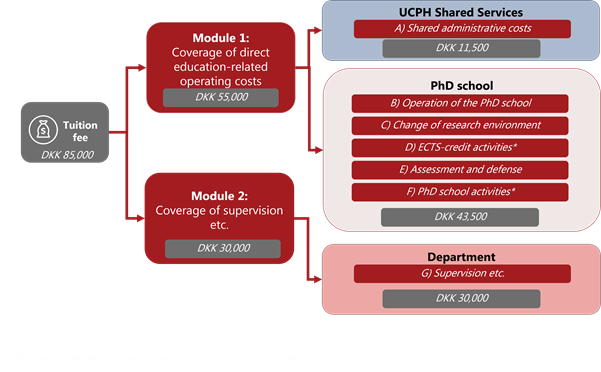
The tuition fee covers costs incurred by the University's PhD Schools, departments and administration in connection with PhD studies. The model applies to all types of enrolment. The tuition fee amounts to DKK 255,000 and is generally charged in three instalments of DKK 85,000 each.
The tuition fee consists of two modules:
- Module 1 (DKK 55,000) is compulsory for all PhD studies, regardless of funding arrangements and place of employment. The module covers costs related to the PhD School and shared administrative expenses, as well as a range of direct costs associated with the PhD studies.
- Module 2 (DKK 30,000) covers the department's costs for supervision and related activities in connection with the PhD studies. For PhD students whose principal supervisor’s primary appointment is outside the University of Copenhagen, Module 2 is not charged by the University.
Does the new tuition fee model apply to PhD students who were enrolled before 2027?
Yes partly. Transitional arrangements apply to PhD students who were enrolled before 1 January 2027. The specific tuition fee requirements depend on the student's enrolment year (see below).
PhD students are not required to pay tuition fees themselves. The cost is covered as part of the funding for the PhD project.
The tuition fee is payable in three instalments. The first instalment is charged upon enrolment, while the second and third instalments are charged during the second and third years of the studies.
If a student completes their PhD studies in less than three years, any remaining tuition fee will be charged, ensuring that the full tuition fee of DKK 255,000 has been paid before the degree is awarded.
Transitional arrangements for PhD students already enrolled
- PhD students enrolled in 2024 or earlier are not required to pay the new tuition fee.
- PhD students enrolled in 2025 are required to pay the new tuition fee for their third year of study (2027), corresponding to a minimum of DKK 55,000 (the amount for Module 1).
- PhD students enrolled in 2026 are required to pay the new tuition fee in the remaining instalments for their second year of study (2027) and third year of study (2028).
What amount should be budgeted for tuition fees in future research grant applications?
Frequently Asked Questions
The new tuition fee was approved in June 2026 and will be implemented on 1 January 2027.
We are continuously developing and clarifying processes and procedures related to the implementation of the new model. If you cannot find the answer to your question here, we recommend that you contact the PhD Administration about rules and guidelines, or your local finance partner for information about specific project finances.
This page is updated regularly with as questions and answers become available.
The tuition fee finances a range of key elements of the PhD studies, including:
- Change of research environment (up to DKK 45,000)
- ECTS-credit-bearing activities
- Assessment of the thesis
- Defence of the PhD thesis
- Supervision
- Administration of the PhD programme
The tuition fee helps ensure:
- Access to supervision throughout the PhD studies
- Opportunities to participate in relevant ECTS-credit-bearing activities
- Financial support for a change of research environment in accordance with the applicable rules
- Assessment and defence of the PhD thesis
Invoicing and Payment
The tuition fee is not paid by the PhD student personally. It forms part of the overall funding of the PhD scholarship and is covered either by external funding associated with the PhD project or by the faculty or department financing the scholarship.
- The first instalment is invoiced upon enrolment.
- The second and third instalments are invoiced automatically in the second and third year of enrolment, respectively.
The same rules apply to this type of enrolment.
This is still being clarified. The page will be updated once a final decision has been made.
- Yes, tuition fees are charged during the first three years of enrolment regardless of progression.
- Maternity/paternity leave, illness, leave of absence or an extension do not result in any additional tuition fee charges.
If you submit your thesis before all three instalments have been invoiced, any outstanding tuition fees will be charged in accordance with the applicable rules.
No, the studies costs DKK 255,000 and this amount must be paid before the degree is awarded. No exemptions are granted.
Module 2 covers the costs of supervision and other activities related to the PhD tudies and may be charged by the principal supervisor's employing institution.
-
It is the principal supervisor’s primary appointment that determines whether Module 2 will be charged. If the principal supervisor’s primary appointment is at the University of Copenhagen, Module 2 is charged by the university.
- For PhD students whose principal supervisor’s primary appointment is outside the University of Copenhagen, Module 2 is not charged by the University.
Change of Research Environment
Funding of up to DKK 45,000 may be granted for a change of research environment during a six-month stay:
- Up to DKK 20,000 for the first month
- Up to DKK 5,000 per month for the following five months
Please note: The detailed guidelines for the implementation and administration of the scheme are currently being prepared. Until then, please follow the existing practice.
If the costs exceed the funding available through the tuition fee model, supplementary funding must be sought from other sources.
Guidelines for application, approval and reimbursement are currently being prepared and will be published on www.phd.ku.dk.
The answer depends on local guidelines and funding arrangements. Please contact your department or local finance partner for guidance.
Courses and ECTS-Credit-Bearing Activities
The procedure for reimbursement of expenses related to external courses is currently being prepared and will be published once it has been finalised. Until then, please follow the existing practice.
No. The tuition fee does not function as an individual budget for each student.
Instead, an ongoing assessment is made of which activities can be funded in accordance with the applicable guidelines.
Yes. There may be activities and expenses that fall outside the scope of the tuition fee model. A more detailed overview will be published once the guidelines have been finalised.
Enrolment and Invoicing
As part of the enrolment process, you will be asked to provide invoicing information.
The requirements depend on whether you are:
- A PhD student employed by the University of Copenhagen
- Externally employed in Denmark
- Externally employed outside Denmark
Details of the specific information required are provided during the enrolment process and in the material you receive from the PhD Administration.
Why is a new tuition fee model being introduced?
The tuition fee model has been developed based on a review and calculation of the costs associated with PhD students across the University of Copenhagen during the period 2023-2025.
The new model is based on five key principles:
- Clear decision authority
- Equal high quality and basic conditions across KU
- Transparency and compliance
- Fair allocation of tasks and funds
- Efficient, simple administrative process for all
Contact
- If you have any questions about the rules and guidelines, please contact the PhD administration.
- The PhD administration serves as the first point of contact for questions relating to the PhD studies. Certain enquiries may be forwarded to the relevant financial partners.