
PhD tuition fee
We are continuously developing and clarifying processes and procedures related to the implementation of the new model. If you cannot find the answer to your question here, we recommend that you contact the PhD Administration about rules and guidelines, or your local finance partner for information about specific project finances.
This page is updated regularly as new questions and answers become available.
How is the model structured?
The tuition fee covers the costs incurred by the PhD Schools, departments and administration in connection with PhD studies. The model applies to all types of enrolment. The tuition fee amounts to DKK 255,000 and is generally charged in three instalments of DKK 85,000 each.
The tuition fee consists of 2 modules:
- Module 1 (DKK 55,000) is compulsory for all PhD studies, regardless of funding arrangements and place of employment. The module covers costs related to the PhD School and shared administrative expenses, as well as a range of direct costs associated with the PhD studies.
- Module 2 (DKK 30,000) covers the department's costs for supervision and related activities in connection with the PhD studies. For PhD students whose principal supervisor’s primary employment is outside the University of Copenhagen, Module 2 is not charged by the University.
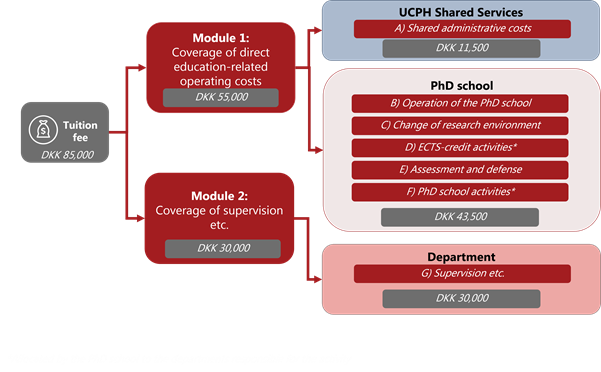
What does the tuition fee cover?
The tuition fee covers costs incurred by the University's PhD Schools, departments and administration in connection with PhD studies, including:
- Change of research environment (up to DKK 45,000) in accordance with applicable guidelines
- Funding for eligible ECTS-awarding activities in accordance with applicable guidelines
- Assessment of the thesis
- Defence of the PhD thesis
- Supervision
- Operation of the PhD School
- Administration of the PhD programme
Support for PhD school activities, for example:
- Department of PhD environments
- PhD days,
- mid-term evaluations,
- career days,
- well-being activities and other academic and social initiatives.
What does the tuition fee not cover?
Certain costs are not covered by the tuition fee and must be funded separately, either as direct project costs or as part of the department’s ordinary operation expenses.
Direct project costs
These are costs directly related to the research project itself and include, for example:
- Fieldwork, data collection, and other project-specific travel and subsistence costs
- Use of core facilities and specialised research infrastructure
- Books, software and research materials
- Publication costs, including open access fees
- Participation in conferences, scientific events and similar activities that are not ECTS-awarding
- Other project-specific research activities
The level of these costs depends on the nature and requirements of the individual project and should be budgeted for in future research grant applications.
Department operating costs
These are costs the department funds directly as part of its ordinary operations, and include, for example:
- Reception after the PhD defense
- Roll ups, fliers and promotional material in general
- Basic office and IT equipment, such as laptop and mobile phone
Costs incurred under track B-E in the model will be harmonised across the university. The criteria and procedures governing funding under the tuition fee model are currently being developed by the operational steering group for the implementation project, consisting of the Head of PhD Schools forum members.
Costs incurred under track F are not governed by university-wide criteria. Decisions on funding, eligibility and local priorities are made by the individual PhD Schools and may therefore differ across the University.
Transitional arrangements for PhD students already enrolled
The following rules apply to PhD students who are already enrolled:
- PhD students enrolled in 2024 or earlier are not required to pay the new tuition fee. *
- PhD students enrolled in 2025 are required to pay the new tuition fee for their third year of study (2027), corresponding to a minimum of DKK 55,000 (the amount for Module 1). *
- PhD students enrolled in 2026 are required to pay the new tuition fee in the remaining instalments for their second year of study (2027) and third year of study (2028). *
* It is assumed that all enrolled PhD students have paid between one and three tuition fee instalments, depending on their year of enrolment. Any outstanding tuition fee due on or after 1 January 2027 will be charged under the new tuition fee rules.
All research grant applications that include funding for PhD students must now budget for the PhD studies to cost DKK 255,000 in tuition fees (three instalments of DKK 85,000 each).
If the grant provider does not cover the full tuition fee amount, the difference must be covered by the employing department. No exemptions will be granted.
For PhD students
Focus: What does Tuition Fee model mean for me and my PhD programme?
Tuition fees and your PhD studies
The PhD programme at the University of Copenhagen is a fee-based educational programme. The tuition fee is DKK 255,000.
The tuition fee model helps ensure equal high-quality educational opportunities and a common set of basic conditions for PhD students across the University of Copenhagen. It finances key educational elements of the PhD programme, including supervision, funding for ECTS-awarding activities, funding for a change of research environment and assessment and defence of the thesis.
The tuition fee helps ensure that all PhD students have access to:
- Supervision throughout the PhD programme
- Funding for ECTS-awarding activities in accordance with the applicable guidelines
- Funding for a change of research environment in accordance with the applicable guidelines
- Assessment and defence of the PhD thesis
No. The tuition fee cannot be paid by individuals. The tuition fee forms part of the overall funding of the PhD scholarship and is covered either by external funding linked to the PhD project or by the faculty or department funding the scholarship.
As part of the enrolment process, you will be asked to provide invoicing information.
The requirements depend on whether you are:
- A PhD student employed by the University of Copenhagen
- Externally employed in Denmark
- Externally employed outside Denmark
Details of the specific information required are provided during the enrolment process and in the material, you receive from the PhD Administration.
Yes. All PhD students enrolled at the University of Copenhagen can obtain funding for eligible activities under the tuition fee model, including a change of research environment, ECTS-awarding activities, and assessment and defence of the thesis, provided that the activities meet the applicable requirements.
Separate transitional arrangements apply to the payment of tuition fees for students enrolled before 1 January 2027. Please see Transitional arrangements for PhD students already enrolled above [link]. These arrangements do not affect eligibility for funding under the tuition fee model.
Early submission of the thesis does not reduce the total tuition fee.
The tuition fee is charged in three instalments. The first instalment is charged upon enrolment, and the following two instalments are charged in the second and third years respectively.
If you submit your thesis before all three instalments have been charged, any outstanding tuition fee will be charged to ensure that the full tuition fee of DKK 255,000 has been paid before the degree is awarded.
You will not be awarded a PhD degree.
Depending on the circumstances and the timing of the discontinuation, the project funding the PhD may be eligible for a partial refund of tuition fees already paid.
Courses and ECTS-accredited activities
As part of your PhD programme at the University of Copenhagen, you are required to complete PhD courses or equivalent educational activities corresponding to a minimum of 28.0 ECTS credits and a maximum of 35.0 ECTS credits. These courses and activities may be completed at UCPH or at other universities in Denmark or abroad.
Courses and equivalent activities can be approved as part of your PhD programme even if they are not eligible for funding under the tuition fee model. In such cases, alternative funding must be obtained from other sources.
The procedure for claiming reimbursement for external course expenses is currently being developed. Further information and guidelines will be published once they have been finalised. Until then, please follow the existing practice at your PhD school.
No. The tuition fee does not function as an individual budget or account for each PhD student. Instead, funding decisions are made on an ongoing basis in accordance with the applicable guidelines.
Please see the section "What does the tuition fee not cover?"
In addition, some activities and expenses will be subject to limits or specific funding conditions.
If you are unsure whether a particular activity can be funded, please contact the PhD administration for advice. [link til kontaktside]
Change of research environment
A change of research environment can be approved as part of your PhD programme even if it is not eligible for funding under the tuition fee model. In such cases, alternative funding must be obtained from other sources.
Please note: Detailed guidelines for the implementation and administration of the scheme are currently being developed. These may include specific funding conditions, such as minimum stay duration and eligibility requirements relating to the location of the stay. For example, stays involving little or no additional costs beyond ordinary commuting expenses may not be eligible for financial support.
We expect to finalise the requirements by the end of October 2026 and will update the PhD Portal and this FAQ. Until they are available, you should follow the existing practice at your PhD School.
Funding of up to DKK 45,000 may be provided for a six-month change of research environment:
- Up to DKK 20,000 for the first month
- Up to DKK 5,000 per month for the following five months
If the costs exceed the funding available under the tuition fee model, supplementary funding must be obtained from other sources, such as the project, the department or external foundations. If additional funding is not available, the plans for the change of research environment may need to be adjusted.
It is anticipated that applications will be submitted through PhD Planner from 1 January 2027. Guidelines for applications, approval and payment/reimbursement are currently being developed and will be published on the PhD Portal www.phd.ku.dk once finalised.
Until then, please follow the existing practice at your PhD school
Funding that has already been allocated or accumulated locally for a planned change of research environment falls outside the scope of the tuition fee model. Decisions regarding such funding remain a local matter and are not affected by the PhD School's administration of the tuition fee scheme.
Special circumstances
- The tuition fee is charged during the first three years of enrolment, regardless of your progress in the programme.
- Maternity or paternity leave, illness, leave of absence or an extension will not result in any additional tuition fees.
The same tuition fee rules apply to these types of part-time and flexible enrolments.
This is still being clarified. The page will be updated once a final decision has been made.
The same tuition fee rules apply to Industrial PhD enrolments.
For Supervisors
Focus: Supervisory responsibilities and the significance of the principal supervisor’s place of employment.
Tuition Fee
Yes. All PhD students enrolled at the University of Copenhagen can obtain funding for eligible activities under the tuition fee model, including a change of research environment, ECTS-awarding activities, and assessment and defence of the thesis, provided that the activities meet the applicable requirements.
Separate transitional arrangements apply to the payment of tuition fees for students enrolled before 1 January 2027. These arrangements do not affect eligibility for funding under the tuition fee model.
The first tuition fee instalment will be charged on enrolment.
The second tuition fee instalment will be charged during the first six months of the second enrolment year.
The third tuition fee instalment will be charged during the first six months of the third enrolment year.
As part of the enrolment process, you will be asked to provide invoicing information.
The requirements depend on whether the student is:
- Employed by the University of Copenhagen
- Externally employed in Denmark
- Externally employed outside of Denmark
Details of the specific information required are provided during the enrolment process and in the material, you receive from the PhD Administration.
The tuition fee is charged during the first three years of enrolment, regardless of the student's progress in the programme.
Maternity or paternity leave, illness, leave of absence or an extension will not result in any additional tuition fees.
Early submission of the thesis does not reduce the total tuition fee.
The tuition fee is normally charged in three instalments. If your PhD student submits their thesis before all three instalments have been charged, any outstanding tuition fee will be charged to ensure that the full tuition fee of DKK 255,000 has been paid before the degree is awarded.
Depending on the circumstances and the timing of the discontinuation, the project funding the PhD may be eligible for a partial refund of tuition fees already paid.
Supervision and Module 2
Module 2 (DKK 30,000) covers the departments’ expenses for supervision and related activities during the PhD programme. The funding is transferred to the departments and does not constitute an individual budget for a specific PhD student. The department has discretion over how the funds are used to support supervision and related activities.
If you are the principal supervisor and your primary employment is at the University of Copenhagen, payment of Modulen2 to is mandatory.
If you are the principal supervisor and your primary employment is outside of the University of Copenhagen, Module 2 is not paid to the University.
The PhD programme
The tuition fee funds a number of key elements of the PhD programme, including:
- Change of research environment (up to DKK 45,000)
- ECTS-awarding activities*
- Assessment of the thesis
- Defence of the PhD thesis
- Supervision
- Administration of the PhD programme
As part of a PhD programme at the University of Copenhagen, a PhD student is required to complete PhD courses or equivalent educational activities corresponding to a minimum of 28.0 ECTS credits and a maximum of 35.0 ECTS credits. These courses and activities may be completed at UCPH or at other universities in Denmark or abroad.
Funding for ECTS-awarding activities is subject to the applicable guidelines and may be subject to caps on the number of activities or the level of funding available.
Courses and equivalent activities can be approved as part of your PhD programme even if they are not eligible for funding under the tuition fee model. In such cases, alternative funding must be obtained from other sources.
A change of research environment is a mandatory part of the PhD programme. The supervisor therefore plays an important role in planning the stay and supporting the student throughout the process.
- The supervisor is expected to help identify relevant institutions, research groups, or organisations that can support the student's research project, including through their professional network.
- The supervisor must approve the proposed change of research environment.
- The supervisor is expected to assist the student in estimating the costs of the stay and, where necessary, identifying additional funding sources if the total costs exceed the funding available through the tuition fee model or the PhD School.
Completion of PhD courses and equivalent educational activities is a mandatory part of the PhD programme. The supervisor therefore plays an important role in planning and approving these activities.
- The supervisor should help ensure that the student's planned courses and educational activities comply with the requirements of the PhD programme, including any minimum, maximum or mandatory requirements.
- The supervisor is expected to assist the student in estimating the costs of planned activities and, where necessary, identifying additional funding sources if the costs exceed the funding available through the tuition fee model or the PhD School.
Special types of PhD programme
The same tuition fee rules apply to Industrial PhD enrolments.
This is still being clarified. The page will be updated once a final decision has been made.
Contact
- If you have any questions about the rules and guidelines, please contact the PhD administration.
- The PhD administration serves as the first point of contact for questions relating to the PhD studies. Certain enquiries may be forwarded to the relevant financial partners.